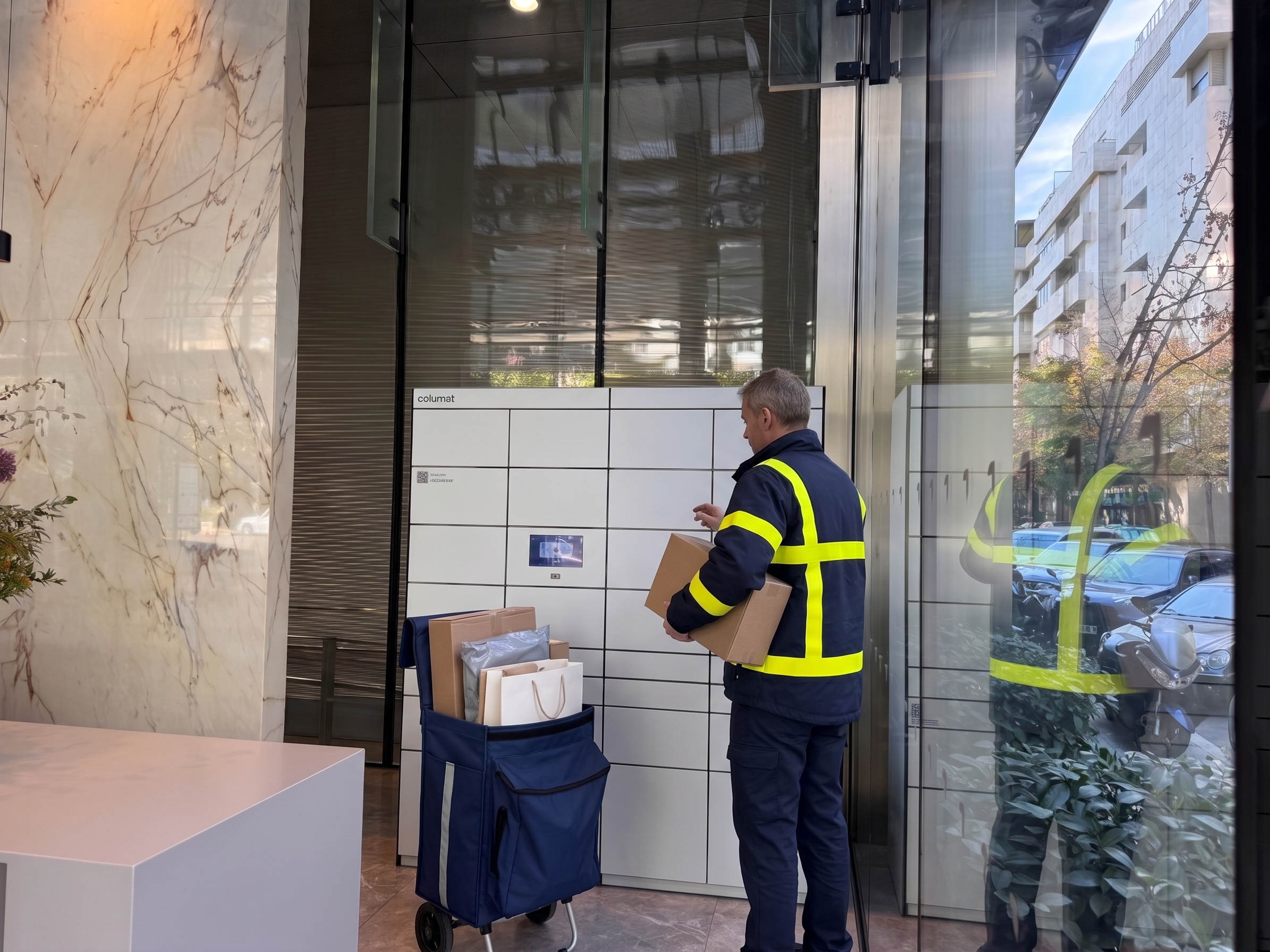
Between late November and mid-January, every reception point —whether it's the lobby of a corporate building, an office, a coworking space, a student residence or a residential complex with a concierge— will absorb a quarter of the year's parcels in just seven weeks.
In a space with a daily flow of around 400 regular users, handling that avalanche —signing for the courier, logging the parcel, notifying the recipient, storing it and handing it over— takes more than 50 hours of work in a single month. That's more than six full working days spent acting as a logistics warehouse, while access control, phone calls, incidents and front-desk service are left unattended. Calculate how many it will be at your reception.
If your plan for this Black Friday is to handle it "like every year", a bottleneck is guaranteed.
The hidden cost at reception: more than 6 working days lost per month
Each parcel looks like a harmless two-minute task. The problem is the cumulative effect when daily volume almost doubles. Some workplace management software providers estimate at least 10 minutes per delivery (Envoy). To stay conservative, let's run the numbers with half that time for a typical building, workplace or residence:
| Scenario variable | Conservative estimate |
|---|
| Regular users of the space | 400 people (employees, coworkers, residents or tenants) |
| Parcels on a normal day | 12 parcels/day (average of 0.05 per person on site) |
| Parcels in peak season | ~20 parcels/day (×1.7 pace) |
| Handling time per parcel | 5 minutes (receipt, logging, notification, storage and handover) |
| Total impact (30 working days) | ~1 h 40 min per day (50+ hours in total) |
But the hours spent are only the tip of the iceberg. Overload triggers three immediate operational risks in any lobby:
- The warehouse effect: Almost one in five recipients (19.4%) needs at least one reminder to come and collect their order (Envoy). Every forgotten box takes usable space away the next day.
- Liability for damage and loss: Spanish online retailers report an average of 5.5% damaged parcels (DS Smith, via PuroMarketing). If a box is damaged or goes missing at an overloaded front desk with no intake log or secure storage, the dispute lands on building management.
- A weaker image of the space: 75% of people admit they have judged an organisation or property by the first impression of its lobby (Wakefield Research for Envoy). A desk overflowing with cardboard boxes signals disorder to visitors, clients, prospective residents and tenants.
Why the avalanche ends up at your desk (and doesn't stop after the holidays)
This isn't a one-off problem; it's structural. Spain shipped 1.335 billion parcels in 2025 —148% more than in 2019— and e-commerce revenue exceeded €114.8 billion (CNMC).
Why do they pile up at receptions and concierge desks? Because at delivery time, people aren't at home: 83.4% of employed people in Spain did not work from home a single day in 2025 (INE, EPA). With nobody home, places with a staffed reception —offices, coworking spaces, student residences, coliving or buildings with a concierge— become the safest and most reliable delivery address (a habit reflected in the 91% of shipments delivered to a home or workplace according to the CNMC, and one that in markets like the US reaches 69% of corporate building users, for availability and security).
| Industry indicator | Key figure | Source |
|---|
| Expected shipments, Black Friday and Christmas 2026 campaign | ~127 million (4.4 million/day on average) | UNO, via Alimarket |
| Peak delivery days | Up to 5.5 million shipments in a single day | UNO |
| Concentration in peak season | ~25% of annual volume between 23 Nov and mid-January | SEUR, via Alimarket |
| Peak day vs. normal day | Almost double (12.4M vs. 6.7M in Germany) | DHL, 2025 |
In multi-tenant buildings, coworking centres and residences, the effect is multiplied: a single central reception absorbs the orders of hundreds of people or dozens of different companies, each with its own habits and no common rules.
And the overload doesn't end on 6 January. Since 35% of online shoppers return at least one product (CNMC), throughout January your desk will shift from handling inbound parcels to coordinating return pickups.
What fails first when volume spikes
When daily flow goes from 10 to 30 or 50 parcels, informal systems always break down in this order:
- Space: Parcels spill from behind the desk onto the lobby floor or into unlocked rooms. Secure storage disappears.
- Logging: A notebook or spreadsheet works with low traffic, but at peak times someone stops logging "just for a moment" and traceability is lost.
- Notifications: Writing or calling recipients one by one eats up critical minutes. When it's postponed, the parcel sits taking up space for days.
- Handover: Without collection deadlines or identity checks at pickup, nobody knows who took what.
- January returns: Nobody has defined where returns are dropped off or who deals with the courier collecting them.
- Cover: If the regular receptionist or concierge is off for a day in December, the system grinds to a halt because nobody else knows how it works.
Faced with this, some managers take the drastic route: in the UK, 12% of organisations went as far as banning personal parcel deliveries (Barclaycard). However, pushing the problem onto users —employees, coworkers or residents— usually creates friction and detracts from the experience of the space.
7 no-budget measures to protect your reception before Black Friday
You don't need a budget to absorb the hit, but you do need clear rules in place before the last week of November:
- Write and share a parcel policy: Define what is accepted, size and weight limits, a ban on perishables and collection deadlines. Send it to all users —employees, coworking members, residents or building tenants— before Black Friday.
- Set a 48–72 hour storage limit: Make clear what happens after that: a single reminder and, if there's no response, return to sender.
- Digitise the intake log: Record date, time, carrier and recipient on the spot. If you use paper, move it today to a shared cloud spreadsheet the whole reception team can access.
- Get boxes out of sight: Set up a locked room or cabinet with restricted access. Whatever sits on the desk is neither secure nor a good look.
- Automate notifications: Set up a simple flow (using a form or internal tool) that sends an automatic email or message when a parcel is logged.
- Create pickup time windows: Concentrate handovers in two slots (for example, 12:00–14:00 and 17:00–18:00) to avoid constant interruptions while dealing with visitors or building incidents.
- Set a January protocol and assign a backup: Define a dedicated area for outgoing returns and train a backup person who can take over if the regular receptionist is off sick or on holiday.
The next step: automating the internal last mile
When the volume in a building, office, coworking space or residence exceeds the staff's operational capacity, manual measures fall short. That's why more and more space managers are turning to smart parcel lockers: the courier drops off the delivery directly without going through reception, and the recipient gets a unique code to collect it 24/7, at any time.
It's already an established habit: in Spain, 18.2% of online shoppers already use lockers as their regular pickup point (CNMC, via Alimarket), and that same convenience and autonomy is now reaching corporate buildings, residential properties and flexible spaces.
How many hours will parcels take up at your reception this peak season?
Answer a few quick questions about your space and get a report with your estimated hours, what will fail first and where to start.
Calculate my reception →Sources (checked on 12/11/2026)
- CNMC · Annual Postal Sector Report 2025 (August 2026): 1.335 billion parcels, +148% vs 2019, 35% returns.
- CNMC via Onda Vasca · E-commerce 2025 (July 2026): €114.8bn, +20.6%.
- CNMC via Alimarket · Household panel, H2 2025 (June 2026): 91% home or workplace, 18.2% lockers.
- UNO · Black Friday and Christmas 2025 forecast (November 2025): peaks of 5.5 million shipments per day.
- Alimarket · SEUR and UNO, 2026 campaign (October 2026): ~127 million shipments; 25% of SEUR's annual volume in two months.
- DHL · Black Friday week 2025 (December 2025): almost double a normal day in Germany.
- INE · EPA 2025, working from home (March 2026): 83.4% did not work from home a single day.
- Envoy · Wakefield Research, 1,000 US office workers (2019): 69% have received personal parcels at work.
- Envoy · Delivery management: 10 minutes per delivery (vendor estimate), 19.4% need a reminder.
- Barclaycard via InternetRetailing (2016, UK): 8% receive purchases at work daily; 12% of companies ban them; 7% installed lockers.
- DS Smith via PuroMarketing (January 2026): 5.5% of parcels damaged.