
Most organisations track their direct costs with surgical precision: payroll, rent, software licences, supplier contracts. Yet there is another cost category that appears on no financial dashboard and that, in a 500-employee company, can exceed €300,000 per year. It is called physical friction: the cumulative economic loss generated by uncontrolled, untraceable and manually dependent physical processes. Saturated reception desks, untracked packages, failed internal handovers, IT technicians spending hours managing equipment logistics. None of these costs appear as a budget line. But together, they silently erode operational efficiency — and they are entirely measurable. This article provides a practical audit framework to identify, quantify and prioritise them.
Physical friction is any process that requires in-person human intervention, calendar coordination or manual handling to complete an exchange of objects, documents or assets within an organisation. It is not an abstract concept: it materialises every time a receptionist signs for a parcel that goes unclaimed for three days, every time an IT technician physically delivers a laptop because there is no centralised handover system, or every time an employee spends 20 minutes tracking down someone available to collect a delivery.
In hybrid working environments — which by 2026 represent over 70% of large European corporations according to Eurostat data — physical friction multiplies. Physical workflows have not kept pace with the new reality: people are in the office intermittently, but packages, equipment and materials arrive every single day.
According to Facility Management sector benchmarks consolidated in 2026, a company with between 500 and 1,000 employees handles between 40 and 80 undigitised physical exchanges daily. If each generates an average friction of 12 minutes — across preparation, delivery, waiting and manual logging — that equates to between 8 and 16 operational hours consumed daily in processes that should be autonomous.
Auditing physical friction requires identifying where it originates. There are five primary vectors, all documented in corporate environments with more than 500 employees:
Reception areas concentrate 65% of unplanned operational congestion in hybrid-model companies. The root cause: reception continues to act as a physical intermediary for personal and professional parcel management, key handling, visitor control and internal material distribution. Each interruption carries an average handling cost of between 8 and 15 minutes, including the cognitive recovery time of the interrupted worker.
In a 600-employee company with two reception staff members, if each handles an average of 25 physical interruptions daily, the monthly cost in personnel time alone exceeds €4,200 — before accounting for the opportunity cost of tasks left undone.
43% of parcels received in offices without a management system pass through at least three different people before reaching their intended recipient. Along that journey, items are lost, damaged, forgotten or — in the case of sensitive materials — accessed without any record. The cost is not only financial: in regulated sectors such as banking, insurance or pharmaceuticals, it is also a compliance risk.
Analysis of real delivery flows in corporate environments shows that 43% of loss or damage incidents occur during the internal delivery phase, not during the logistics operator's transit. The chain of custody breaks the moment a parcel enters the building.
IT, Maintenance, Facilities and HR share a structural problem: they need to deliver and collect materials (equipment, PPE, documentation, keys) to and from people who are not always available at the same time. The result is what practitioners call failed exchanges: 70% of internal delivery attempts require more than one attempt because they depend on two people being physically present simultaneously.
Each failed exchange generates, at minimum, one coordination email, one additional journey and a delay in the originating process. In IT departments handling more than 50 weekly equipment management requests, this can represent over 30 hours of unproductive work monthly — purely in internal logistics coordination.
52% of IT department interruptions in mid-to-large companies relate to the physical management of equipment: deliveries, collections, replacements and temporary loans. Each support ticket involving a physical hardware movement carries a management cost that, according to 2026 sector benchmarks, ranges from €35 to €85 per incident when technician time, travel and administrative coordination are factored in.
A 600-employee company with a normal equipment rotation rate can generate between 80 and 120 of these movements per month. At the minimum cost of €35 per incident, the annual impact exceeds €33,600 for IT asset management alone.
In companies offering catering or canteen services, 75% of delivery processes remain in-person and dependent on rigid time slots. In hybrid environments, this generates both food waste (uncollected orders) and employee dissatisfaction (inability to adapt collection to actual working hours). The cost of waste from uncollected orders in corporate canteens serving more than 200 employees can reach €15,000 annually for collective catering operators.

The Friction Point Inventory (FPI) is a structured diagnostic method in three phases that enables Facility Management and Operations leaders to quantify their organisation's physical friction and prioritise areas of improvement by economic impact.
The first step is to inventory all recurring physical flows within the organisation. A physical flow is any process involving the movement of an object between two points within the premises, or between the outside world and the building.
Categories to map:
For each flow, document: daily/weekly frequency, number of people involved, average time per incident and the percentage of incidents requiring more than one attempt.
With the inventory complete, apply the friction cost formula per category:
Friction cost = (Frequency × Average time per incident × Hourly cost of the role involved) + Failed incident cost × Failure rate
For practical application, these are the reference parameters for a standard corporate environment in 2026:
Once all friction points have been quantified, rank them by economic impact and calculate the potential ROI of automation. The vectors with the highest return are typically reception and parcel management (due to high frequency and the relatively high cost of the roles involved), followed by IT and technology assets (due to high per-incident unit cost).

To illustrate the scale of the problem, we apply the FPI method to a representative but fictional organisation: a 600-employee financial consultancy in a single headquarters with a hybrid working model (50% average in-office occupancy), two floors and a two-person reception team.
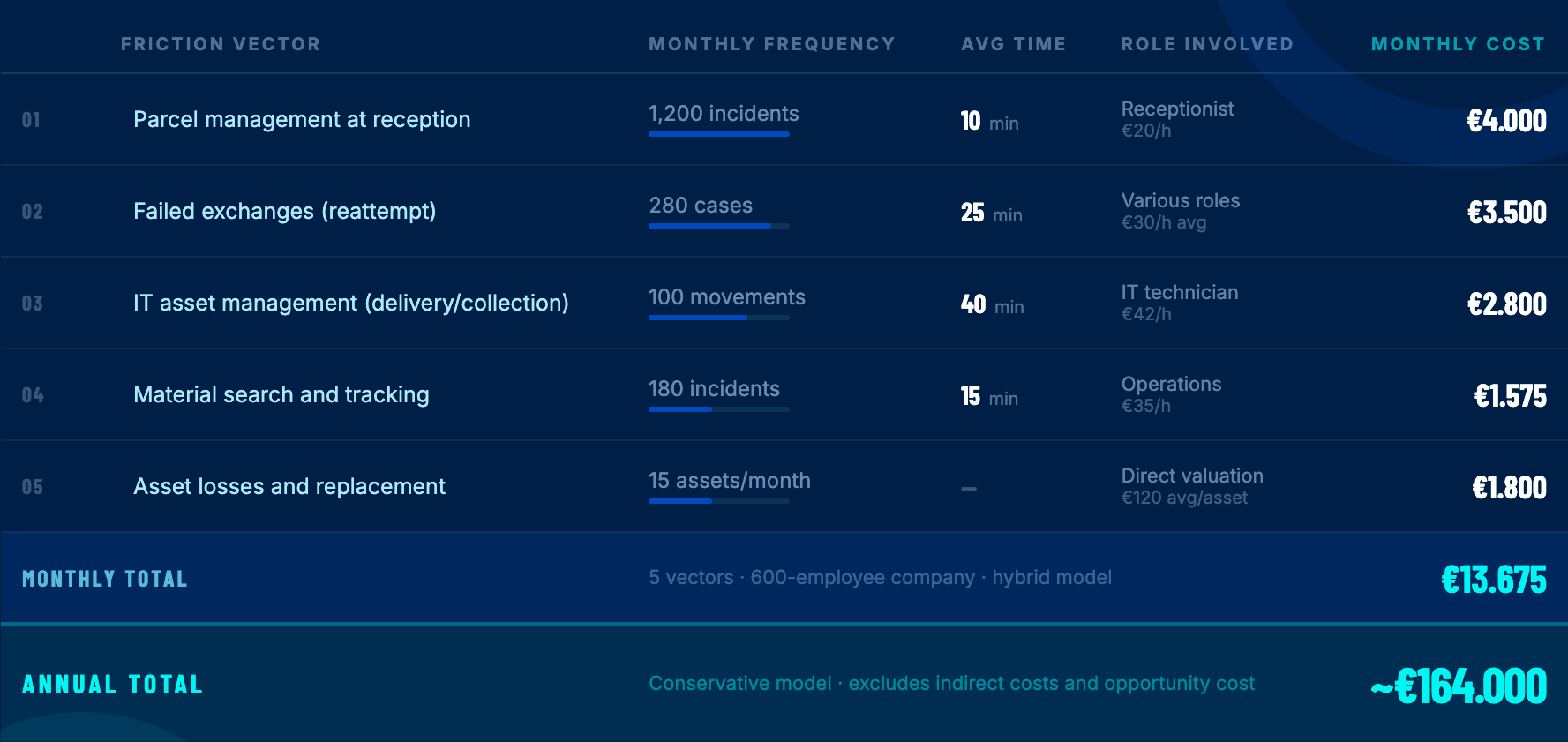
This conservative model — which excludes opportunity costs and the productivity impact on employees receiving the interruptions — already exceeds €164,000 per year. When indirect costs documented in workplace productivity research are incorporated (each unplanned interruption carries a cognitive recovery cost of 10 to 23 additional minutes, according to research from the University of California), the real impact can easily double, surpassing €300,000 annually in organisations of this profile.
Deloitte's Future of Work Operations 2026 report notes that organisations that have digitised their internal physical workflows report an average 38% reduction in indirect operational costs in the first year of implementation.
The following benchmarks enable a rapid assessment of an organisation's physical friction level. If your company exceeds the alert threshold in three or more categories, physical friction is already a significant operational efficiency issue:
Reception:
Parcel management:
Internal exchanges:
IT assets:
Operational time on physical management:
The goal of a physical friction audit is not to produce a report — it is to generate a digitisation roadmap for physical workflows, prioritised by economic impact. FPI results should translate into three types of decision:
Decision 1 — Eliminate friction at source. For the highest-frequency, highest-impact flows, the most efficient solution is to remove the need for human intervention entirely through automation. Autonomous physical exchange management systems (delivery, collection, secure storage) enable 24/7 operation without dependency on staff availability.
Decision 2 — Digitise traceability. For flows that cannot be fully automated, the priority is end-to-end digital traceability: who delivered, who collected, when, and in what condition. This eliminates loss costs and resolves compliance issues in regulated industries.
Decision 3 — Measure to improve. Once any physical flow management system is in place, KPIs must be monitored monthly. The most relevant metric is not the number of parcels processed but the evolution of friction time per category and the cost of failed incidents.
Organisations that have implemented this approach report consistent results: a 55–63% reduction in time spent on manual physical management, a 38–47% decrease in internal journeys and travel, and an improvement in internal NPS of 15–25 points in the six months following digitisation.
What is physical friction in a company and how does it affect productivity?Physical friction refers to the processes that require manual human intervention to complete physical exchanges: parcel delivery, equipment management, material coordination. It generates hidden costs in time, travel and errors that do not appear in budgets but that in 500+ employee companies can exceed €150,000 annually.
How much does untracked parcel management really cost in an office environment?Beyond the cost of a lost parcel, the real cost includes reception handling time (10–15 min per incident), the recipient's time searching for the package, redelivery attempts and compliance risk for sensitive materials. In a 500-employee company receiving 40+ parcels daily, the monthly cost of manual management exceeds €4,000.
How do I know if my company has a physical friction problem?The clearest signals are: reception handling more than 25 unplanned interruptions per person daily, more than 30% of internal exchanges requiring more than one attempt, and more than 15% of IT tickets with a logistics component. If three or more of these signals are present, physical friction is already impacting operational efficiency significantly.
Which physical processes can be automated in a corporate office environment?Those with the highest impact and greatest technical viability are: parcel receipt and custody (personal and professional), IT equipment and asset delivery and collection, key and physical access management, asynchronous cross-departmental exchanges, and secure storage for employees, visitors and external contractors.
How long does it take to see ROI after digitising physical workflows?Physical workflow digitisation projects in corporate environments report a payback period of 8 to 14 months, depending on exchange volume and current management costs. Savings in personnel time and incident reduction are typically visible within the first 90 days.
What is the difference between automating physical workflows and simply outsourcing reception?Outsourcing transfers the cost but does not eliminate the friction: the process remains manual and people-dependent. Automation removes the need for human intervention for the majority of flows, guarantees 100% traceability and enables autonomous 24/7 operation — which is particularly critical in hybrid working models where the office is not always staffed during standard business hours.


.png)