
The headline numbers look promising. Office occupancy across European business districts has recovered significantly since 2023, with average in-office rates stabilising between 60–70% for hybrid-first companies. And yet, a growing body of operational data tells a more complicated story: employees are coming back — but they're not staying, not escalating their days, and not recommending the experience. Return-to-office (RTO) mandates in 2026 are stalling at the adoption ceiling, and the culprit is rarely culture. It's friction.
This article maps the hidden operational friction points that Facility Managers, HR leaders, and Operations Directors are systematically underestimating — and the data that explains why addressing them is no longer optional.
The dominant narrative around return-to-office resistance focuses on employee sentiment: flexibility preferences, commute costs, work-life balance. These are real. But they're also largely fixed variables for most organisations — they were known before mandates were issued and are difficult to change in the short term.
What is controllable — and where organisations are consistently underinvesting — is the operational experience of being in the office. According to a 2026 Leesman workplace experience benchmark, the gap between employee satisfaction at home versus in the office is no longer primarily emotional. It's functional. Employees describe the office as a place where simple tasks take longer, coordination requires more effort, and the physical environment creates interruptions that remote work eliminates.
In practical terms, this translates into three categories of measurable friction:
None of these appear on engagement surveys. All of them compound daily.
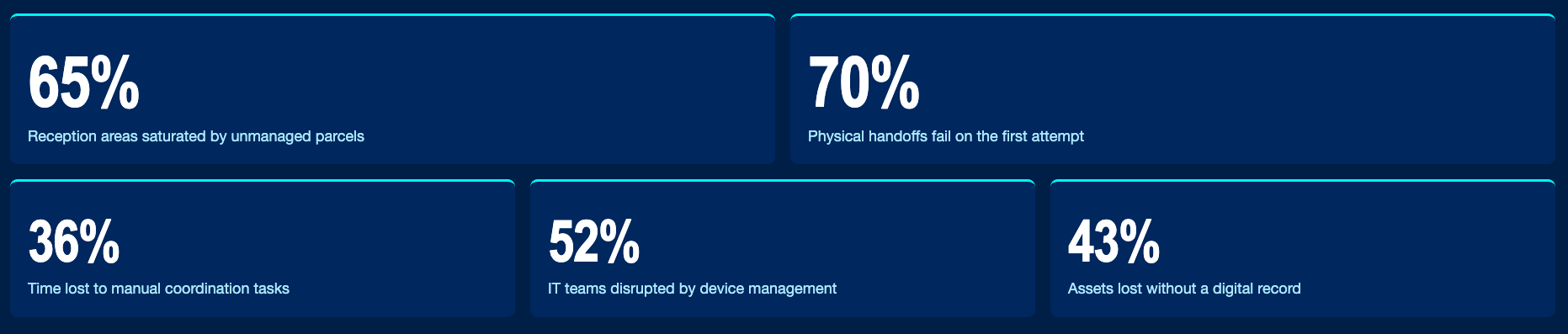
Operational data collected across multi-site corporate environments in 2026 reveals the scale of the problem in concrete terms:
These numbers share a common thread: they describe systems designed for full-time, synchronous presence being operated in hybrid, asynchronous realities. The physical infrastructure of the office has not been updated to match the behavioural infrastructure of how work actually happens in 2026.
In 2026, the average large corporate office receives between 40–80 parcels per day — a combination of personal deliveries (the "office as delivery address" behaviour that hybrid work has normalised) and professional shipments. Without a managed handoff system, this volume falls entirely on reception staff, who are simultaneously managing visitor flows, access control, and front-of-house responsibilities.
The result: an average of 63 hours per month lost across reception, facilities, and administrative functions to unscheduled parcel management. More damaging is the downstream effect — employees who know parcels are not reliably managed choose not to use the office as a delivery address, reducing one of the small but measurable incentives to be present.
Modern hybrid schedules mean that colleagues who need to exchange physical objects — a laptop going for repair, a client gift, a contract requiring a signature — are rarely in the office simultaneously. Traditional processes assume presence. The handoff either waits (creating delays), requires coordination overhead (calls, messages, calendar holds), or simply fails.
Data from multi-floor corporate environments indicates that 70% of cross-team physical handoffs require more than one attempt. Each failed attempt costs an average of 23 minutes in rescheduling and follow-up. Across an organisation of 500+ employees, this represents a substantial and entirely invisible productivity tax.
IT departments in hybrid environments face a structural problem: the lifecycle of physical devices — issuance, collection, repair, recharge, reissuance — was designed for a world where people were always present and predictable. In 2026, they're not.
The consequence is that 43% of devices are not ready for use at the start of a shift due to uncharged batteries, untracked location, or incomplete repair loops. For IT teams, device management has become a primary operational pain point — 52% report it as their top source of unplanned weekly interruptions. For employees, arriving to find that a device they need is unavailable creates exactly the kind of experience that reinforces the "the office doesn't work as well as home" narrative.
In environments where physical objects — keys, access cards, sensitive documents, personal effects — move without digital registration, loss rates are predictable and high. 43% of organisations with manual handoff processes report regular incidents involving missing or misplaced items with no audit trail. The operational cost of each incident (time to investigate, reissue, replace) is significant. The reputational and compliance cost — particularly for regulated industries — can be severe.
In 2026, with GDPR enforcement increasingly focused on physical document handling and access management, the absence of a digital log for physical handoffs is becoming a governance risk, not just an operational inconvenience.
Perhaps the most counterintuitive friction point: organisations have invested substantially in making offices aesthetically and ergonomically attractive for RTO — standing desks, wellness rooms, collaborative zones. But operational friction undermines the experiential investment. An employee who arrives at a beautifully designed office, waits 15 minutes for a parcel that "should be at reception," discovers their loaned laptop hasn't been returned, and is interrupted twice by IT queries, does not leave with a positive experience — regardless of the quality of the coffee or the view.
According to JLL's 2026 Workplace Experience Report, 73% of employees who report high satisfaction with the office describe a workplace where physical processes work reliably and without friction. The amenity investment and the operational investment are not interchangeable. Both are necessary.
Organisations achieving above-average RTO adoption rates in 2026 share a common operational pattern: they have digitised the physical layer of the office. This means:
The measurable outcomes from environments where these systems are in place are consistent: a 55% reduction in reception congestion, a 38% decrease in coordination-related movement, and 63+ hours per month recovered across administrative functions. Beyond the efficiency numbers, the employee experience effect is significant: in offices where physical processes are invisible and reliable, NPS scores for the in-office experience increase by an average of 70 percentage points versus environments where they are manual and unpredictable.
The principle is straightforward: employees will choose the office more often when the office works better than the alternative. In 2026, closing that gap is an operational problem, not a cultural one.
For Facility Managers and HR leaders building the business case for operational investment, these are the benchmarks to track:

These KPIs should be integrated into broader RTO metrics alongside occupancy rates. An office with 70% occupancy and 34% operational satisfaction is a different problem — and requires a different solution — than one with 55% occupancy and 80% operational satisfaction.
Why are RTO mandates failing in 2026 despite increased office occupancy?
Higher occupancy does not equal successful adoption. Many organisations are seeing employees comply with minimum attendance requirements without increasing voluntary days — a signal of passive resistance driven by poor in-office experience. Operational friction, not cultural resistance, is increasingly identified as the primary barrier to higher voluntary adoption.
What is the biggest hidden cost of unmanaged parcel delivery in corporate offices?
The direct cost is staff time — typically 63+ hours per month across reception and facilities functions. The indirect cost is higher: failed deliveries, employee frustration, and the erosion of the office as a practical base for hybrid workers who rely on it as a delivery point.
How does asynchronous physical handoff failure affect hybrid team productivity?
When physical handoffs require simultaneous presence — and schedules don't align — each failure costs an average of 23 minutes in rescheduling. Across a team of 20 with even moderate handoff frequency, this represents 5–8 hours of lost productivity per week.
What operational changes have the highest ROI for improving RTO adoption?
According to 2026 workplace operations benchmarks, automating physical handoff processes (parcels, equipment, documents) delivers the highest return — combining direct time savings, measurable NPS improvement, and compliance benefits. The investment is recoverable within a single financial year in organisations above 300 employees.
Is physical asset traceability a compliance requirement in 2026?
For regulated sectors (financial services, healthcare, legal), the answer is increasingly yes. GDPR enforcement has expanded to include physical document handling, and audit requirements for IT asset management are tightening across the EU. Beyond compliance, organisations face reputational and operational risk from unlogged physical handoffs.
How do you measure the operational experience of the office separately from the cultural experience?
Use operational KPIs (handoff success rate, device availability, parcel resolution time) alongside experience surveys that separate "physical environment" from "operational efficiency" as distinct dimensions. The Leesman LMI framework and JLL's Experience Index both include operational sub-scores that can be tracked quarter-on-quarter.


.png)