
The building that delivers the lowest operational friction commands the highest rent. This was once an assumption reserved for logistics real estate — where throughput and dock efficiency dictated cap rates. In 2026, it is becoming a mainstream principle across office, mixed-use, and residential premium assets. Property managers and asset managers who have not yet embedded operational performance into their value proposition are already losing ground in tenant negotiations.
This article maps the structural shift underway: why operational infrastructure is migrating from a facilities expense to a yield-generating asset, and which measurable indicators are reshaping the way institutional landlords, REITs, and flex operators price their portfolios.
For decades, the three dominant drivers of commercial real estate value were location, specification, and lease terms. These remain relevant — but they are increasingly insufficient as standalone metrics.
The post-pandemic restructuring of work patterns has permanently altered tenant expectations. According to JLL's Global Real Estate Outlook 2026, occupiers are now conducting formal operational audits of shortlisted buildings before signing. The question is no longer only "Where is it?" but "How does it work?"
This shift has a direct financial consequence. Buildings that score poorly on operational experience — congested lobbies, inefficient parcel flows, untracked asset handovers, limited 24/7 autonomy — are seeing higher vacancy rates and shorter average lease durations, even in prime locations. Conversely, assets with verifiable operational infrastructure are achieving rental premiums of between 8% and 22% in major European markets, according to data compiled by CBRE in Q1 2026.
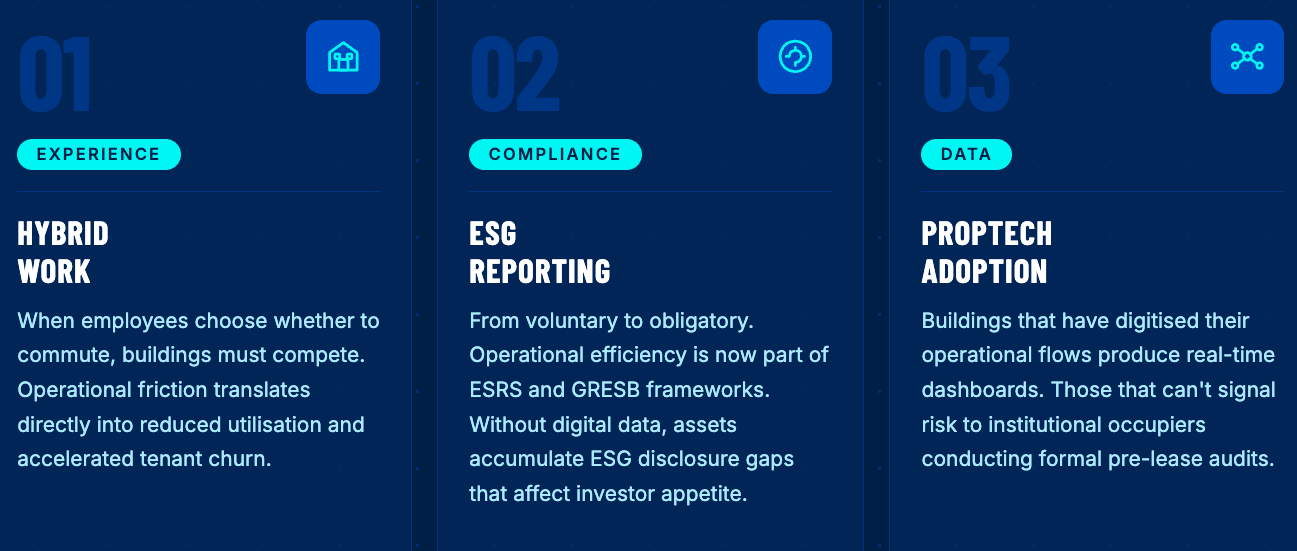
Three structural forces are driving this:
1. Hybrid work has made buildings accountable for employee experience. When employees choose whether to commute, the building itself must compete. Friction — a parcel that went missing, a device that wasn't ready at shift start, a visitor left waiting at reception — translates directly into reduced utilisation and weakened tenant retention.
2. ESG reporting has moved from voluntary to obligatory. Investors and tenants increasingly require buildings to demonstrate not just energy performance but operational efficiency. Physical process management — who accessed what, when, with what accountability — is becoming part of sustainability disclosure frameworks.
3. PropTech adoption has created a measurability gap. Buildings that have digitised their operational flows can produce dashboards. Buildings that haven't cannot. In an era where occupiers demand data, the inability to provide operational metrics is itself a risk signal.
Operational infrastructure refers to the systems, technologies, and processes that govern how physical exchanges — deliveries, asset handovers, access control, intralogistic flows — are managed within a building.
It is a category that has historically been invisible in asset valuation models. It did not appear on BREEAM scorecards. It was rarely referenced in WELL certification assessments. And it was almost never included in lease negotiation documentation.
That is now changing — and fast.
Internal data from European property operators shows that 65% of building receptions are currently saturated by uncoordinated parcel flows for residents and tenants. The same data identifies that 75% of tenants positively value smart building services, yet fewer than one in four buildings currently offer them in a structured, digitised form.
This gap — between what tenants want and what buildings deliver — is the precise space where operational infrastructure is becoming a valuation variable.
The traditional model of "reception + human intervention + paper log" generates three categories of quantifiable cost for asset managers:
A building operating without digitised operational infrastructure is, in effect, carrying a hidden liability that does not appear on any balance sheet — but which directly affects NOI (Net Operating Income) over time.
The most sophisticated asset managers in 2026 are approaching operational infrastructure in the same way they approach M&E (Mechanical & Electrical) specification: as a technical requirement that affects both yield and risk profile.
Here is the emerging valuation logic:
Industry benchmarks consistently place the total cost of tenant turnover — including re-letting fees, incentive packages, void periods, and fit-out contributions — at between 12 and 24 months of net rent. A building that demonstrably reduces churn by improving operational experience is preserving capital, not just improving comfort.
Buildings with smart operational infrastructure report 73% higher tenant satisfaction scores, a metric that correlates directly with lease renewal probability in occupier surveys.
The "amenity premium" in commercial real estate has historically referred to rooftop terraces, gyms, and food & beverage. In 2026, the definition is expanding to include functional infrastructure: 24/7 autonomous parcel and asset management, controlled-temperature delivery points, contactless access flows, and real-time operational visibility.
The distinction is significant: leisure amenities are differentiators. Functional infrastructure is becoming a baseline expectation — and where it is absent, it is treated as a deficiency.
The next generation of ESG disclosure frameworks — including the EU's ESRS (European Sustainability Reporting Standards) and evolving GRESB metrics — are beginning to incorporate operational efficiency as a component of social and governance performance. Buildings that can demonstrate digital traceability, reduced manual labour, and quantified carbon savings from optimised delivery flows will score materially higher.
To convert operational infrastructure from a qualitative claim into a quantifiable asset driver, property managers need to instrument the right metrics. The following are the indicators emerging as standard in institutional real estate operational audits:

Buildings that can report against these KPIs are increasingly able to use them as evidence in lease negotiations, asset repositioning exercises, and fund-level ESG reporting.
The core reframe required of real estate operators in 2026 is this: operational infrastructure is not a facilities management cost to be minimised. It is a yield-generating asset to be optimised.
This distinction has concrete financial implications.
A building that invests in digitised physical exchange infrastructure — smart locker systems, real-time operational dashboards, API-connected management platforms — is not spending on convenience. It is:
The buildings that institutionalise this logic earliest will hold a structural advantage as occupier expectations continue to harden.
Operational infrastructure is not the future of real estate value. For a growing cohort of tenants in 2026, it is already the present.
What is operational infrastructure in real estate, and why does it affect rental value?Operational infrastructure refers to the digitised systems that govern physical exchanges within a building — parcel management, asset handovers, access control, intralogistic flows. In 2026, it directly affects rental value because tenants are factoring operational friction into their occupancy decisions, with buildings scoring poorly on this dimension experiencing higher vacancy rates and shorter lease durations.
How does smart building operational infrastructure improve NOI?It improves NOI through three channels: reducing tenant churn (which eliminates re-letting costs equivalent to 12–24 months of net rent), enabling premium pricing for operationally verified assets, and generating ancillary revenue streams through services infrastructure. European data from Q1 2026 indicates rental premiums of 8–22% for assets with verifiable operational performance.
Are operational metrics included in ESG real estate frameworks in 2026?Yes, increasingly so. The EU's ESRS and evolving GRESB frameworks are incorporating operational efficiency indicators — including digital traceability, autonomous process rates, and carbon savings from optimised delivery flows — into social and governance scoring. Buildings without operational digitisation are beginning to face ESG disclosure gaps that affect investor appetite.
What percentage of tenants value smart operational services in buildings?Current data indicates that 75% of tenants positively value smart building services — including autonomous parcel management, 24/7 access flows, and real-time operational visibility. However, fewer than 25% of commercial buildings currently offer these services in a structured, digitised form, representing a significant competitive gap for early movers.
What KPIs should property managers use to measure operational infrastructure performance?The emerging standard includes: reception congestion rate (target <15% peak saturation), asset handover traceability (target 100% digital audit), autonomous resolution rate (target >85%), operational carbon per square metre, tenant operational NPS (target >70), and mean time to incident resolution. These KPIs are increasingly used as evidence in lease negotiations and fund-level reporting.
How does operational infrastructure differ from traditional building amenities?Traditional amenities — gyms, terraces, F&B — are differentiators. Operational infrastructure is becoming a baseline expectation. Where it is absent, it is increasingly treated as a functional deficiency rather than a neutral absence, particularly by institutional occupiers conducting formal building audits before lease signing.


.png)