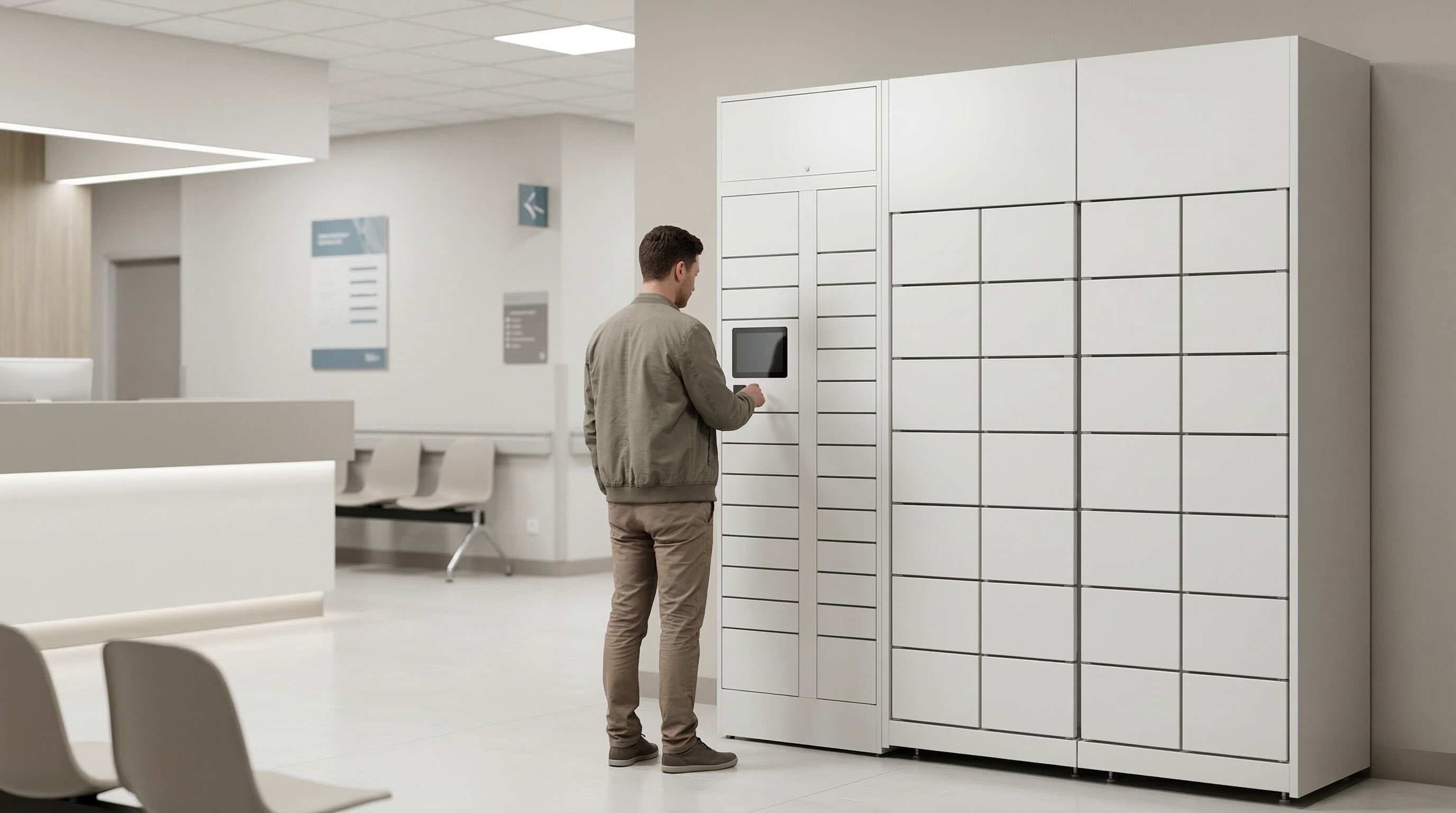
Hospital pharmacies are under structural pressure that no extra headcount can solve. Demand for ambulatory dispensing has grown faster than the physical infrastructure built to support it, and the traditional counter model — where medication flows only when a trained professional is physically present — is reaching its operational ceiling. In 2026, leading healthcare institutions are redesigning dispensing as a distributed network of controlled, programmable endpoints. The counter doesn't disappear: it becomes one node among many.
The centralised pharmacy counter was designed for a world of fixed shifts, predictable patient flows, and single-site hospitals. That world no longer exists.
According to data from the European Association of Hospital Pharmacists (EAHP), over 62% of clinical staff time in hospital pharmacy units is spent on logistics and dispensing coordination tasks rather than clinical review — a ratio that has worsened steadily as patient throughput has increased without proportional resource growth. At the same time, 30% of medication-related errors in clinical settings are attributed to handover gaps: moments when physical custody of a drug passes between people or departments without a documented, audited trace.
The problem isn't the pharmacy. It's the model.
The counter-based model assumes that dispensing always happens in one place, at one time, by one person. But in a complex hospital environment — with 24/7 shift rotations, satellite units, ambulatory care wings, and growing volumes of outpatient prescriptions — that assumption fails multiple times a day. The result is a combination of bottlenecks, workarounds, undocumented handoffs, and compliance risk that accumulates quietly until an incident makes it visible.
Three structural failures define the current model:
Single point of dispensing. When all medication flows through one counter, that counter becomes the constraint. Any surge in demand — post-surgical rounds, shift changes, emergency admissions — queues at a single physical location.
Presence-dependent access. Staff can only retrieve medication when pharmacy personnel are available. In hospitals running lean overnight shifts, this creates access gaps that clinical staff resolve through informal workarounds, often undocumented.
Broken chain of custody. Manual handoffs — from pharmacist to ward nurse, from logistics to bedside — generate audit gaps. When a discrepancy arises, reconstruction depends on memory and paper, not data.
.jpg)
A programmable endpoint network distributes the physical act of dispensing without distributing accountability. The pharmacy retains clinical and governance control; what changes is where and when authorised access to medication occurs.
The architecture rests on three components working in concert:
These are temperature-regulated, identity-authenticated access points placed at validated locations within the hospital — ambulatory pharmacy exits, satellite units, clinical wards, outpatient areas. Each unit operates independently but reports to a central management layer in real time. Access is granted via PIN, QR code, or integration with the hospital's existing ID system. Every open-and-close event is logged with timestamp, user identity, and compartment ID.
Critically, cold-chain integrity is maintained natively. Units designed for pharmaceutical environments hold 2–8°C as a standard operational parameter — not an add-on — which means medication requiring temperature control can be dispensed through the network without breaking the cold chain at the point of patient access.
The pharmacy director or logistics manager retains a real-time view of every endpoint in the network: what is available, what has been accessed, what is pending collection, and what has expired its collection window. This is not passive monitoring — it's active governance. Alerts trigger when a compartment is opened outside expected parameters or when a collected item is not confirmed downstream.
This layer is also where integration with hospital information systems occurs. Through open APIs compatible with SAP, ServiceNow, Oracle Health, and major European HIS platforms, the dispensing network becomes a module within the broader clinical operations stack, not a siloed peripheral system.
The endpoint network enables asynchronous dispensing: the pharmacist prepares and loads medication into the assigned compartment; the patient or ward nurse collects at the appropriate time, notified by automatic alert. Neither party needs to be physically co-present. This is the operational shift that changes the counter model fundamentally — dispensing is decoupled from collection, and both events are documented independently.
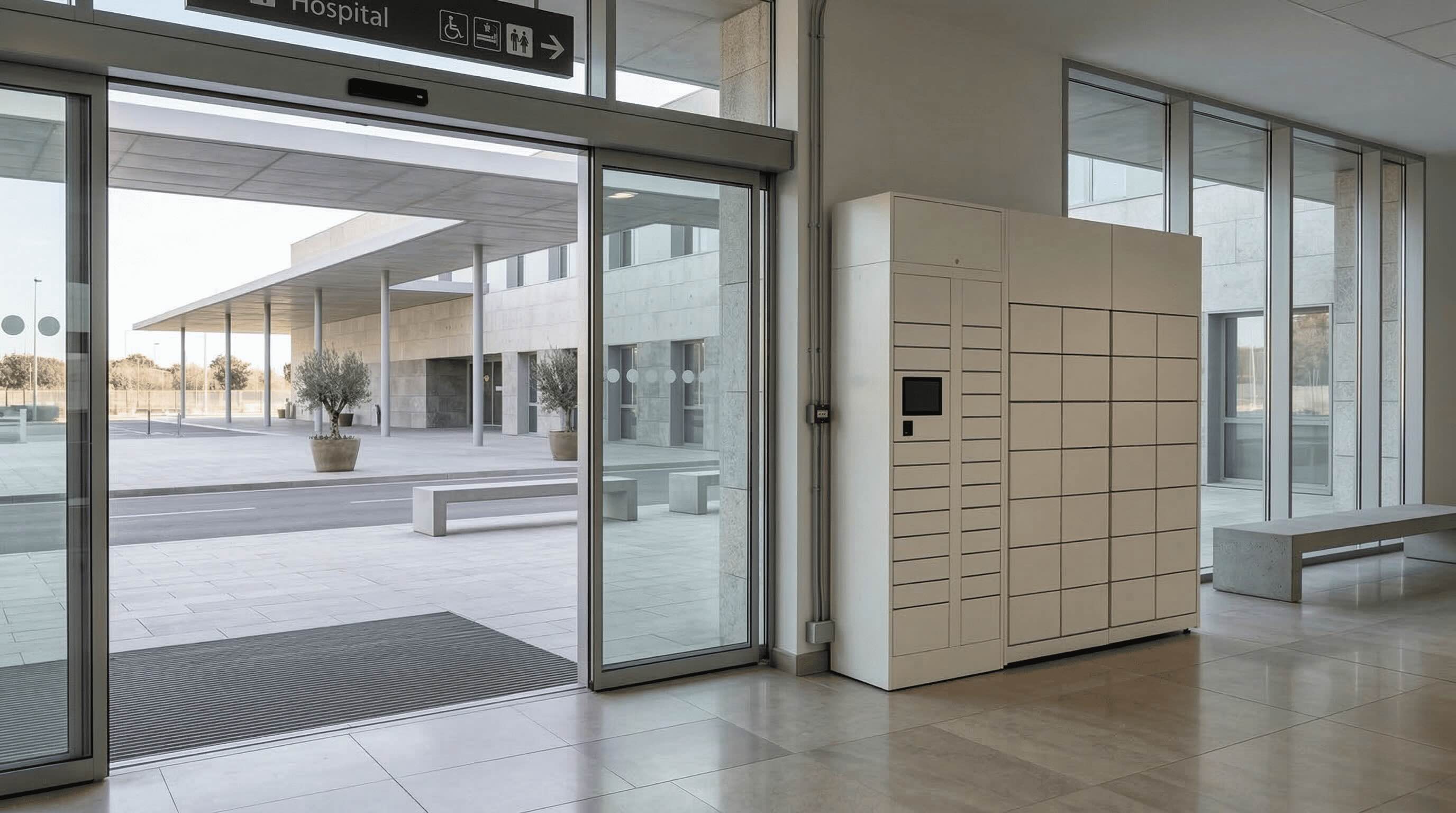
The programmable endpoint model is not a single use case — it is an infrastructure that supports multiple dispensing flows simultaneously within the same hospital.
Ambulatory pharmacy dispensing. Outpatients with chronic prescriptions collect their medication from an authenticated endpoint after it has been prepared by pharmacy staff, without queuing at the counter. Collection can occur during any open hour, including before or after standard pharmacy operating hours. Wait times — historically cited as a primary patient dissatisfaction driver in ambulatory pharmacy — drop significantly.
Clinical sample and specimen handoff. In diagnostic pathways, the chain of custody for biological samples is as critical as the chain of custody for controlled drugs. Programmable endpoints serve as authenticated deposit and collection points for samples moving between clinical units and the laboratory, eliminating the undocumented handoffs that represent the highest-risk moments in sample integrity.
Inter-shift medication transfer. At shift changes, ward nurses require validated access to medications prepared for patients on their watch. An endpoint network provides a structured, auditable mechanism for this transfer, replacing informal handoffs that bypass documentation.
High-value and controlled substance management. For Schedule II and III substances, the endpoint network provides the access controls, audit trail, and chain-of-custody documentation required by regulatory frameworks — without restricting access to a single counter or a single time window.
Quantifying the impact of distributed dispensing infrastructure requires measuring across three dimensions: operational efficiency, clinical safety, and patient experience.
Hospitals that have moved from counter-only to endpoint-network models report consistent patterns across these dimensions:

The compliance dimension is increasingly material. European pharmaceutical regulations (EU Falsified Medicines Directive and national GxP requirements) are placing greater documentation obligations on hospital pharmacies for all dispensed items, including ambulatory prescriptions. A network of authenticated, logged endpoints generates the audit trail required by these frameworks as a byproduct of normal operation — not as an additional administrative layer.
Transitioning to a distributed endpoint model does not require replacing the pharmacy's existing systems. The practical evaluation framework for pharmacy directors and hospital logistics leaders typically covers four areas:
1. Workflow mapping before hardware placement. The value of an endpoint network is determined by where the nodes sit and what flows they intercept. High-value placement points include: ambulatory exit zones with high patient volume, satellite units with documented handoff gaps, overnight access points for ward nurses, and diagnostic pathways with documented sample-custody incidents.
2. System integration requirements. The endpoint management layer must connect to the hospital's existing HIS, ERP, or pharmacy management system. Evaluate vendors on API openness, not on the features of their proprietary software. A closed-architecture endpoint network creates a new silo; an open one extends existing governance.
3. Temperature control as a selection criterion. Not all dispensing endpoints handle cold-chain requirements. For hospitals managing oncology, biologics, insulin, or any medication requiring 2–8°C storage, temperature-controlled endpoints should be treated as a minimum specification, not a premium option.
4. Regulatory documentation output. The endpoint network should produce audit logs in formats compatible with the hospital's compliance reporting requirements. Evaluate whether the system generates chain-of-custody records that satisfy both internal pharmacy governance and external regulatory inspection requirements.
What is a programmable dispensing endpoint in hospital pharmacy?
A programmable dispensing endpoint is a controlled-access storage unit placed at a validated location within a hospital, from which authorised users can retrieve pre-prepared medication or deposit clinical materials. It operates independently of pharmacy opening hours, logs every access event with timestamp and identity, and reports to a centralised management system in real time.
How does a distributed endpoint network differ from traditional automated dispensing cabinets (ADCs)?
Traditional ADCs are standalone units designed primarily for ward-level stock management. A distributed endpoint network is a coordinated architecture of multiple access points managed from a single control layer, with open API integration into hospital information systems, chain-of-custody documentation across the full dispensing-to-collection journey, and support for patient-facing dispensing, not only staff access.
Can endpoint networks handle controlled substances and cold-chain medications?
Yes. Purpose-built pharmaceutical endpoints include compartment-level access authentication, full audit trails for controlled substance handling, and native 2–8°C temperature regulation for cold-chain medications including biologics, oncology agents, and insulin. Temperature maintenance and custody documentation occur simultaneously, as an integrated operational feature.
What are the main compliance benefits of switching to an endpoint network?
The principal compliance benefit is a complete, automated audit trail for every dispensing and collection event — eliminating the documentation gaps that arise from manual handoffs. This directly addresses EU Falsified Medicines Directive traceability requirements and GxP documentation standards for ambulatory pharmacy dispensing without adding administrative burden to clinical or pharmacy staff.
How long does it take to implement a hospital endpoint dispensing network?
Implementation timelines vary by hospital size and integration complexity, but a phased rollout — beginning with one or two high-value workflow points — typically becomes operational within four to eight weeks of project kick-off. Full integration with existing HIS and pharmacy management systems is usually achieved within the first quarter of deployment.
What happens if a patient doesn't collect their medication within the allotted window?
The endpoint management system generates automatic alerts when collection windows expire. Pharmacy staff are notified to review the compartment, and the system logs the event as uncollected with full timestamp data. Protocols for uncollected medication — return to pharmacy stock, extended window, or patient notification escalation — are configurable within the management layer.