The promise of grocery home delivery seemed unbeatable: order online, receive at home, no friction. For a decade, getting products to the customer's door was the defining competitive axis in food eCommerce. But in 2026, that model is showing structural cracks — rising cost per delivery, a failed delivery rate still hovering above 20%, cold chain compliance pressure, and a growing consumer preference for flexible, on-their-own-terms collection. The industry is renegotiating what "last mile" means. And out-of-home (OOH) delivery infrastructure is at the centre of that negotiation.
Last mile food delivery has a cost problem that better logistics management cannot fully solve. Home delivery for grocery and fresh food is the most expensive, most unreliable, and least carbon-efficient model at scale.
According to McKinsey's State of Grocery Retail 2025 report — the benchmark still referenced across the industry in 2026 — the unit economics of home delivery for grocery remain deeply challenging: delivery costs typically represent 15–20% of the order value, making profitability elusive without significant order minimums or delivery fees that push customers away. Deloitte's retail logistics analysis estimates that failed deliveries add an average €8–12 per unsuccessful stop when redelivery, customer handling, and route inefficiency are factored in.
The cold chain dimension compounds the problem. Fresh food, prepared meals, and pharmaceutical-adjacent grocery categories (baby food, specialised nutrition) require unbroken temperature control from warehouse to final handoff. In a home delivery model, that chain depends entirely on the customer being present at the right moment. When they're not — which happens in roughly one in five deliveries — the chain breaks, the product degrades, and the operator absorbs the cost.
This isn't a failure of execution. It's a structural mismatch between a model designed for physical presence and a customer base that lives a hybrid, unpredictable schedule.

Out-of-home (OOH) delivery — defined as any delivery point outside the customer's home, including Smart Lockers, Click & Collect stations, and consolidated drop points — is not a compromise. It is a structurally superior model for a growing proportion of grocery and food eCommerce transactions.
The density argument. A single OOH delivery point can serve 50–200 households in a single drop. Compare that to 50–200 individual home delivery stops, each with its own time window, access challenge, and potential for failure. The route consolidation effect alone delivers an estimated 28% reduction in last-mile logistics congestion, according to operational data from established Smart Locker networks in Northern Europe.
The cold chain compliance argument. A temperature-controlled Smart Locker maintains the 2–8°C window continuously, regardless of when the customer collects. The product arrives correctly, is stored correctly, and is collected at the customer's convenience. There is no dependency on the customer's schedule, no "leave on doorstep" risk for chilled products, and no redelivery cycle triggered by absence.
The failed delivery argument. Failed home deliveries in the grocery sector run at approximately 20% in dense urban markets (Statista 2025, cited as baseline reference). OOH infrastructure effectively eliminates this category of failure: the product is deposited regardless of customer availability. The customer collects when ready. Operators who have deployed temperature-controlled locker networks report a reduction in failed deliveries of up to 47% versus equivalent home delivery volumes.
The sustainability argument. Route consolidation through OOH delivery points reduces vehicle movements, fuel consumption, and CO₂ emissions per delivery unit. For food retailers under ESG reporting pressure in 2026 — particularly those operating under the EU Corporate Sustainability Reporting Directive — this is not a peripheral benefit. It is a measurable, reportable metric.
OOH delivery for food is not the same as OOH delivery for parcels. The moment a grocery operator or meal kit brand shifts collections to a locker network, they introduce a non-negotiable infrastructure requirement: native refrigeration at the point of collection.
This distinction matters enormously. Standard parcel lockers — the kind deployed at scale by postal operators and courier networks across Europe — do not meet food safety requirements. A prepared meal or a chilled ready-to-cook product sitting in a non-refrigerated locker compartment for four hours does not comply with EU Regulation 852/2004 on food hygiene, and it does not meet the basic quality expectation the customer has for fresh produce.
The infrastructure requirement, therefore, is not "a locker with some compartments". It is a modular, temperature-controlled unit capable of maintaining 2–8°C — with continuous monitoring, access audit, and integration into the operator's order management and notification systems.
The practical implications for food retailers evaluating OOH infrastructure:
This is where the gap between generic parcel infrastructure and purpose-built food-grade OOH hardware becomes a strategic decision point for retailers.
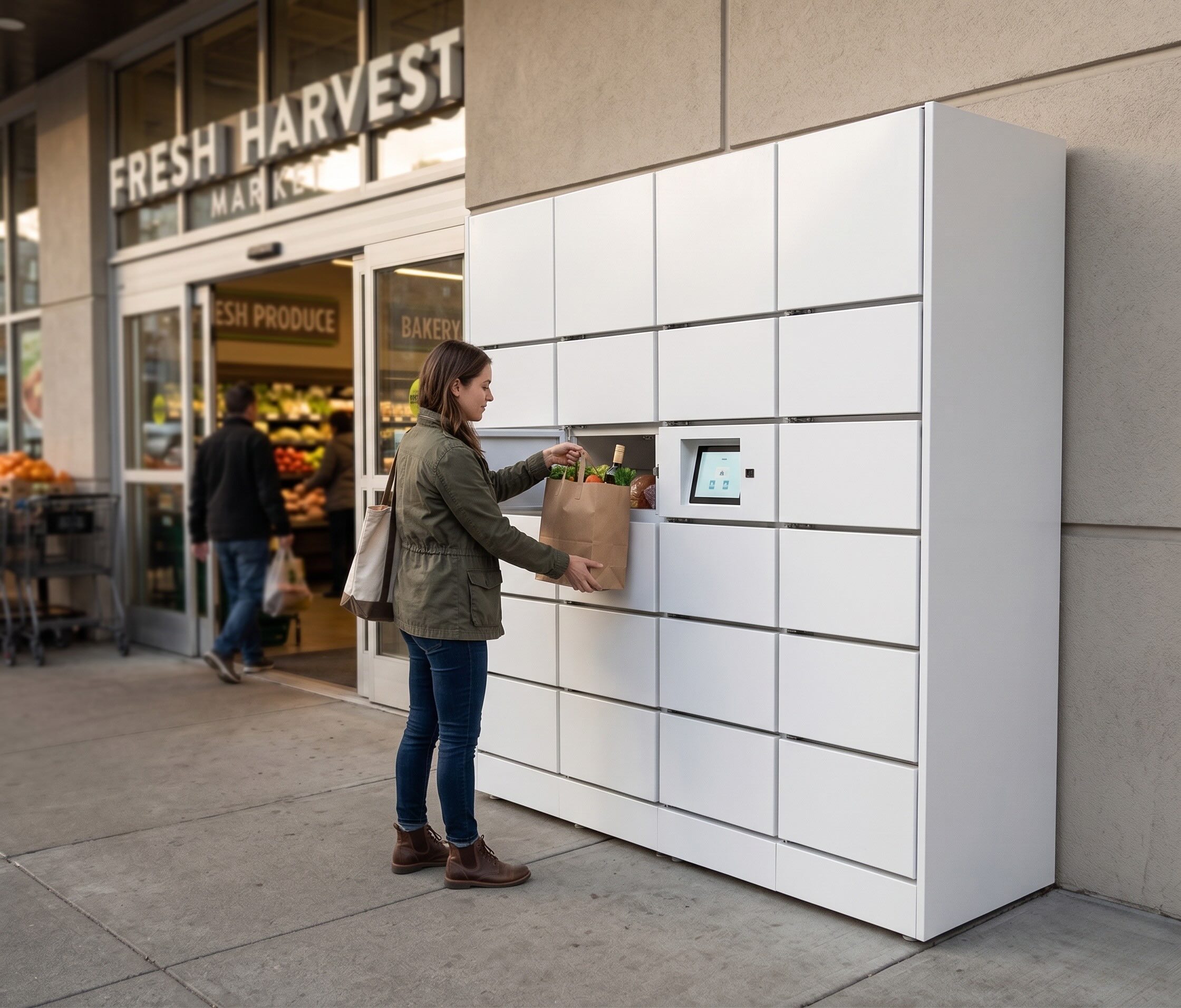
The business case for transitioning last-mile food delivery toward OOH infrastructure is quantifiable. The following benchmarks are drawn from operator data and sector analysis available in 2026:
Failed delivery reduction: up to –47% The primary driver of unit economics improvement. Eliminating redelivery cycles and customer-not-present failures removes the largest variable cost in last-mile food operations.
Logistics congestion reduction: –28%Route consolidation through dense OOH networks reduces vehicle movements per unit delivered. For operators in urban zones with time-window restrictions, this also improves schedule compliance.
Manual task reduction in store/distribution: –63%For retailers deploying Click & Collect with locker integration, the locker handles the handoff autonomously. Staff involvement in the collection process drops to near zero.
Cold chain compliance: 100%Temperature-controlled lockers maintain the required range continuously. Combined with compartment-level monitoring, this delivers audit-ready documentation for food safety inspections — a requirement that is increasingly enforced in the EU in 2026.
Customer satisfaction improvement: +55%Flexibility of collection — on the customer's schedule, not the operator's — is consistently identified as a primary driver of satisfaction in grocery eCommerce. NPS data from OOH-enabled grocery operators shows sustained uplift versus home delivery cohorts.
Carbon footprint reduction: measurable and reportable Route consolidation reduces vehicle kilometres per delivered unit. For operators under CSRD scope in 2026, this translates directly into Scope 3 emissions reduction — reportable against ESG targets and communicable to institutional buyers.

What is OOH delivery in food retail and how does it differ from home delivery?OOH (out-of-home) delivery in food retail refers to any model where the product is deposited at a collection point outside the customer's home — Smart Lockers, Click & Collect stations, or consolidated drop points. Unlike home delivery, OOH does not require the customer to be present at delivery time, eliminating failed deliveries and allowing collection at the customer's convenience.
Why is home delivery still losing market share in grocery eCommerce despite its convenience?Home delivery in grocery carries structural cost problems: high per-stop cost, a failed delivery rate above 20% in urban markets, cold chain compliance challenges when the customer is absent, and increasing CO₂ cost under ESG reporting frameworks. OOH delivery infrastructure addresses all four issues simultaneously.
What are the cold chain requirements for food-grade Smart Lockers?Food-grade Smart Lockers must maintain active mechanical refrigeration in the 2–8°C range, with compartment-level temperature monitoring for HACCP documentation. They must integrate with order management systems for real-time status updates and be capable of modular configuration to match deployment demand. Passive insulation solutions do not meet regulatory food safety standards for multi-hour storage windows.
What is Click & Collect with temperature control and which retail sectors use it?Click & Collect with temperature control is a fulfilment model where a customer orders online and collects their order from a refrigerated locker at a time of their choosing. It is used in grocery retail, meal kit delivery, pharmacy-adjacent food categories, dark stores, and corporate cafeteria services (Cantina 4.0 models). It combines the flexibility of self-service collection with unbroken cold chain compliance.
How does OOH delivery infrastructure reduce carbon emissions in last-mile logistics?By consolidating multiple customer orders into a single delivery drop at one OOH point, operators dramatically reduce vehicle movements per unit delivered. Analysis of established Smart Locker networks indicates reductions of up to 28% in last-mile logistics congestion, with corresponding reductions in fuel consumption and CO₂ per delivered order. For retailers under EU CSRD reporting in 2026, this improvement is directly attributable and reportable.
Is OOH delivery infrastructure cost-effective for small and mid-size food retailers?Yes, when deployed as part of a shared network or as a Click & Collect extension to an existing physical location. The ROI improves significantly when the same infrastructure handles both grocery collection and other use cases (employee meals, parcel management), increasing utilisation rates and amortising fixed costs across multiple revenue streams.