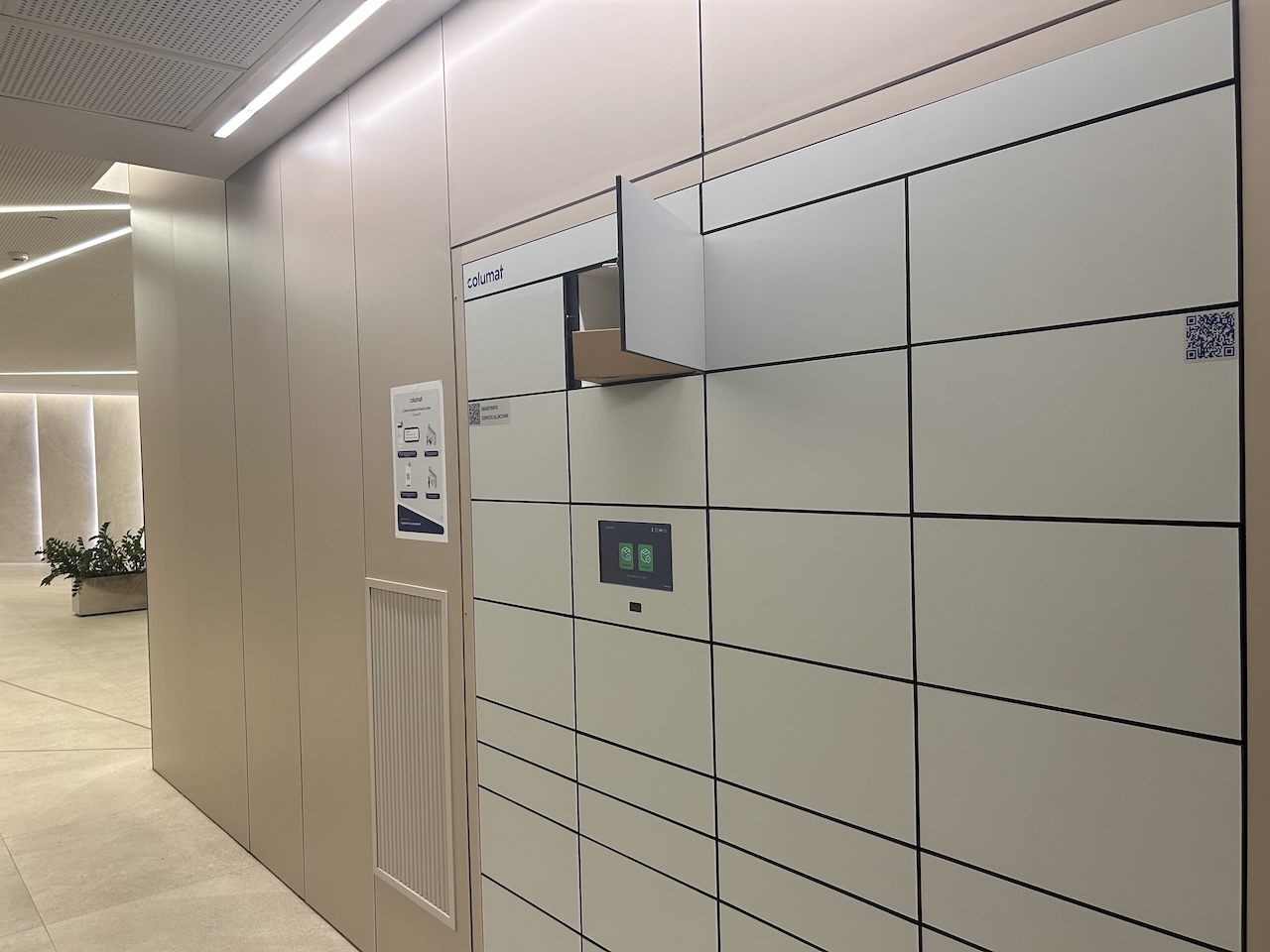
In 2025, Spain moved 1.335 billion parcels: 10% more than the previous year and 148% more than in 2019. Over the same period, traditional postal items fell to 1.164 billion. For the first time on record, the country sent more parcels than letters.
The figures come from the CNMC's Annual Postal Sector Report, published in August 2026. In real estate, this kind of data is almost always read as a logistics story: how goods are delivered, by whom, at what margin.
There is a second reading, and it is the one that affects the asset owner. All of that volume has to land somewhere. 86% of deliveries still go to the recipient's home address; self-service lockers absorb 3% and convenience points 9%. In other words, the overwhelming majority of that flow comes through the lobby of a residential building or the reception desk of an office one.
Buildings whose infrastructure — mailboxes, front desks, waiting areas, access protocols — was designed for a flow of correspondence that no longer exists.
Reducing this to "the parcel problem" understates it, and that is precisely why it rarely reaches the investment committee.
An occupied building handles physical exchanges every day that have nothing to do with e-commerce:
Every one of those flows has one thing in common: today they are all resolved with a person in the middle. Someone receives the item, someone stores it, someone tracks down the recipient, someone notes who collected it — or doesn't.
That someone is usually the reception or facility management team. And that is exactly the point where volume turns into cost.
No building operating budget contains a line called "management of physical exchanges". Which is why nobody optimises it: you cannot cut what you do not measure.
The cost exists, but it is spread across formats that never get aggregated:
There is also an effect the market registers even though nobody accounts for it: the asset's first impression. A lobby stacked with boxes says something about how the building is run, and it says it to the same person being asked to sign a prime rent.
The relevant question for an owner is not whether automation sounds sensible, but what actually moves when you do it.
According to Columat's internal data from projects already deployed, automating these processes can cut up to 55% of the time spent on certain internal logistics tasks.
In assets managed for Colonial, the operation also records:
The second figure matters as much as the first. Infrastructure that gets installed and then goes unused is buried capex; recurring use is what tells you the service has genuinely replaced the manual process rather than sitting alongside it.
There is a third effect, slower to appear but more strategic: the operation starts generating data. How many exchanges the asset handles, in which time bands, with what peaks, which services get used and which don't. Information that simply did not exist before, because the process lived in the concierge's head.
For years this kind of solution has been presented as an extra: one more box on the marketing brochure, next to the gym and the meeting rooms.
That framing is what has prevented it from being properly evaluated. An amenity is judged on whether people like it. Infrastructure is judged on what it costs to run and on what it lets you do without adding headcount.
This is where it connects to asset value. Tenant experience improves when a building offers more services; the classic problem is that each new service adds transactional load to the team, so operating cost grows at the same pace as the promise. Automating the physical layer decouples those two variables: it allows the service offer to expand without a proportional increase in the resources needed to sustain it.
This is not about replacing people. It is about reserving their time for what genuinely requires human judgement — hospitality, attention, resolving problems — rather than for locating a box.
The point gains weight as change-of-use conversions accelerate. An asset moving from offices to flex living, or adding a residential component, is not just redistributing floors: it is changing users, flows and service expectations. A building's flexibility should not be measured only by how easily its partitions move, but by its capacity to absorb new uses without multiplying operational complexity.
Before evaluating any technology, there are three data points almost no owner has to hand — and they define the real size of the problem across a portfolio:
1. How many physical exchanges does the asset handle each day? Not just parcels: keys, devices, documentation, materials. The number tends to surprise people, because it has never been counted.
2. How much of the team's time do they consume?Measured in interruptions, not in blocks of hours. That is the metric that translates volume into cost.
3. What digital evidence remains of each one?If the answer is "none", the asset is carrying a traceability risk that is priced nowhere.
With those three figures, the conversation stops being about lockers and becomes one about the operational efficiency of the asset. Which is where it belongs.
The physical flow passing through a building has multiplied in under a decade. The infrastructure absorbing it has not. The gap between the two is paid for in team time, in poorly used space, and in an experience the tenant certainly notices even if the owner never sees it in a budget line.
Automating that layer does not turn one building into another. It gives it something more basic: the ability to manage and trace its own physical exchanges without every operation ending up at the reception desk.