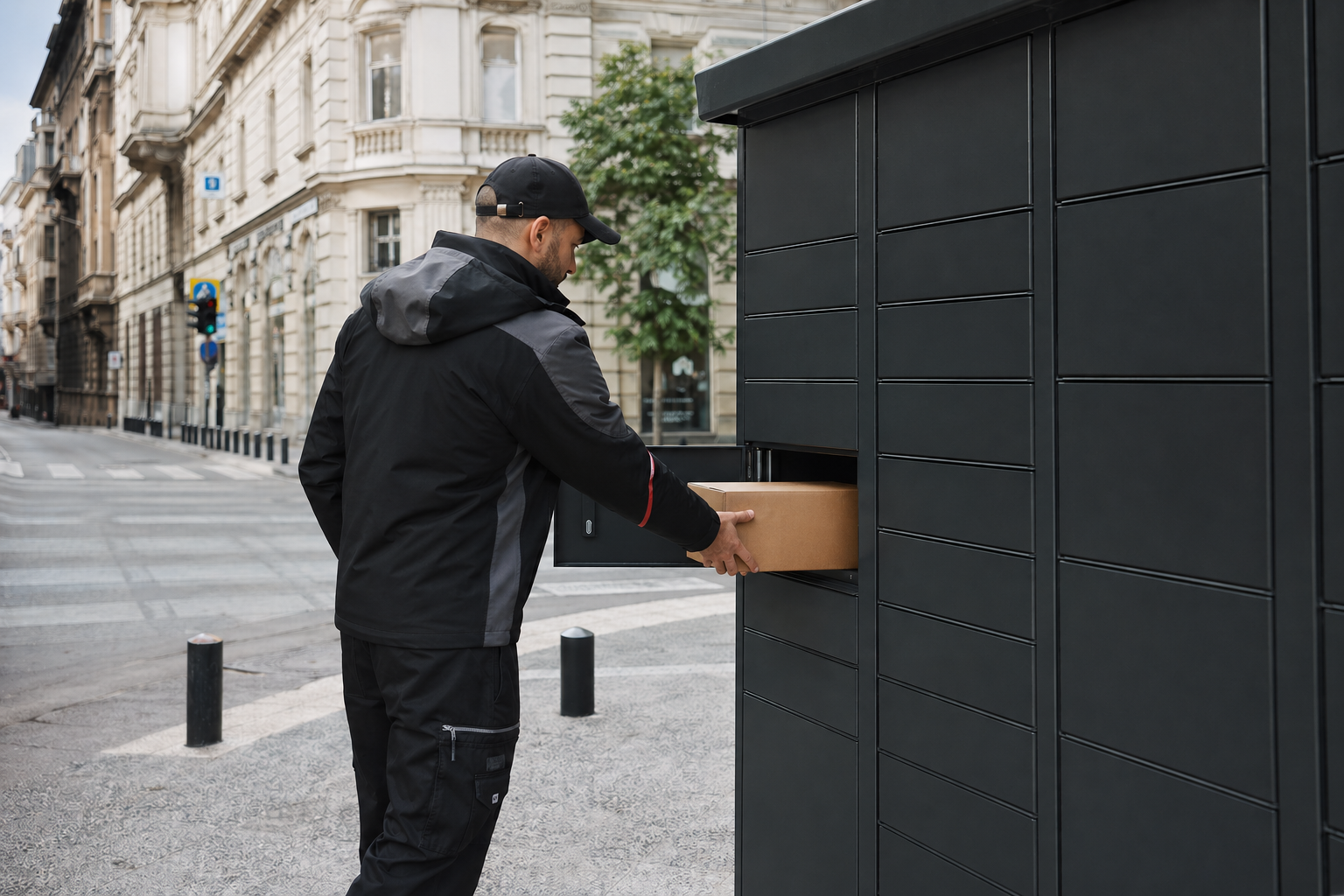
Last-mile delivery has a structural problem that discounts and faster vans cannot fix. In Europe, failed first-attempt deliveries still account for between 20% and 30% of all residential delivery attempts — and every missed door generates a cascade of cost: redelivery scheduling, customer service load, carbon overhead, and eroding net margins on already razor-thin per-parcel economics. The industry has been aware of this for years. What changed in 2026 is that the competitive gap between operators with dense Out-of-Home (OOH) delivery infrastructure and those without has become measurable, material, and widening. For third-party logistics providers and couriers, building or partnering into a robust PUDO (Pick-Up Drop-Off) network is no longer an innovation project. It is a survival imperative.
Out-of-Home delivery — the category that encompasses parcel lockers, PUDO points at retail locations, and shared smart locker networks — has reached an inflection point in Europe. According to industry data tracked across Western and Central European markets, OOH delivery now represents over 25% of all B2C parcel volume in leading markets such as Germany, France, Poland, and the Benelux region. In emerging adopters — Spain, Italy, and Portugal — OOH penetration is accelerating rapidly, driven by urban density pressure and shipper demand for cost reduction.
The structural drivers are not cyclical. They are permanent:
E-commerce volume is not slowing down. European B2C e-commerce surpassed €900 billion in gross merchandise value in 2025 (European E-commerce Report, 2025), and 2026 projections point to continued double-digit growth in cross-border flows. More parcels, same residential access problem.
Consumer behaviour has shifted irrevocably. Post-pandemic, European consumers adapted to collecting parcels on their own schedule. A 2025 consumer logistics survey across six European markets found that 68% of online shoppers prefer flexible collection windows over fixed home delivery slots. That preference has not reversed — it has become a baseline expectation.
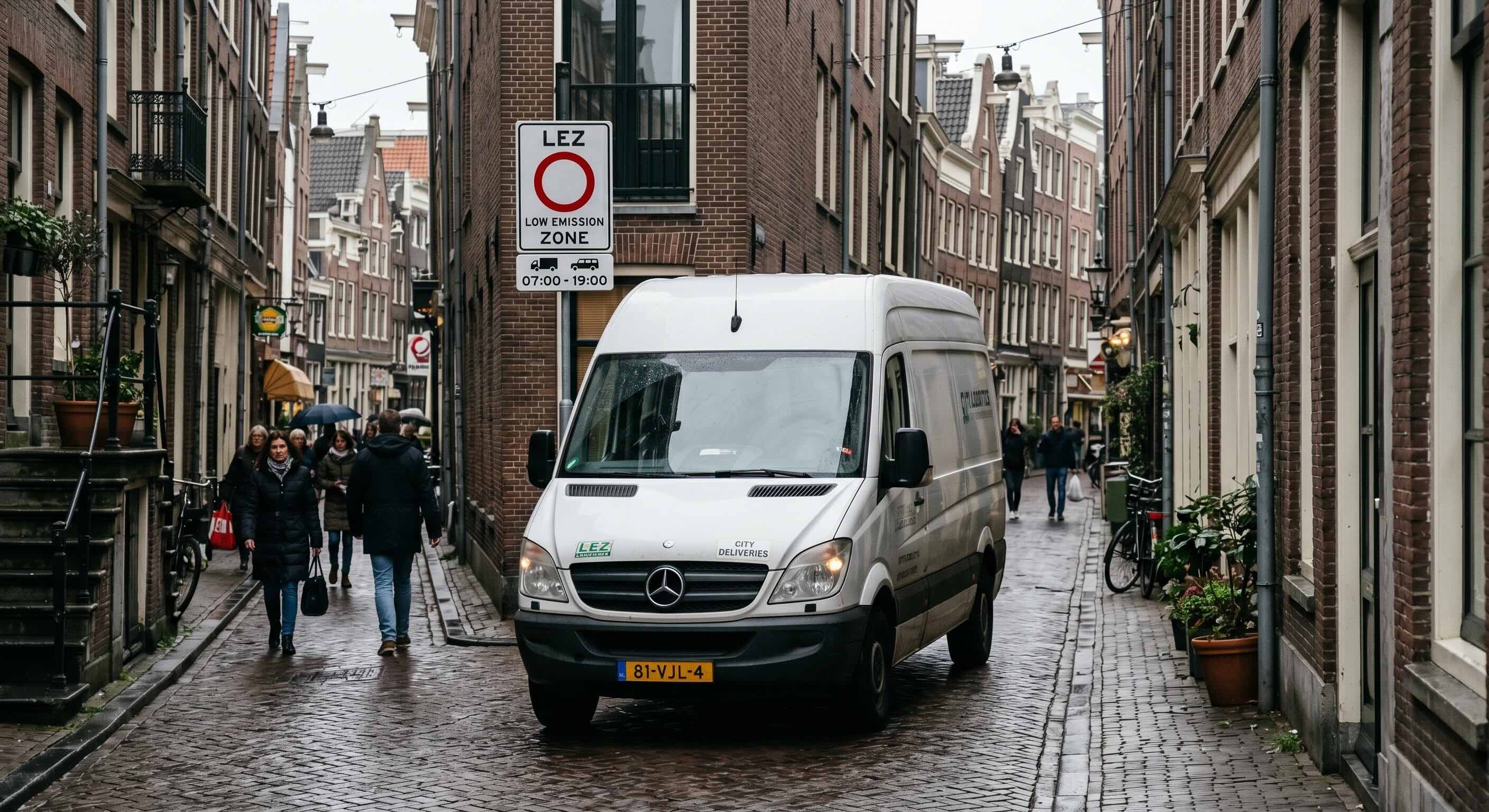
Urban access restrictions are tightening. More than 180 European cities had implemented or legislated low-emission zones (LEZ) or zero-emission delivery corridors by early 2026 (Transport & Environment, 2026). Each additional restriction raises the marginal cost of residential stop density and forces last-mile operators to consolidate delivery points.
Shipper pressure on per-parcel cost is structural. Retailers and e-commerce platforms continue to squeeze carrier margins. OOH delivery consistently delivers 20–35% lower cost-per-parcel compared to home delivery when network utilisation exceeds 60%, making it the primary lever for carriers to protect their commercial model.
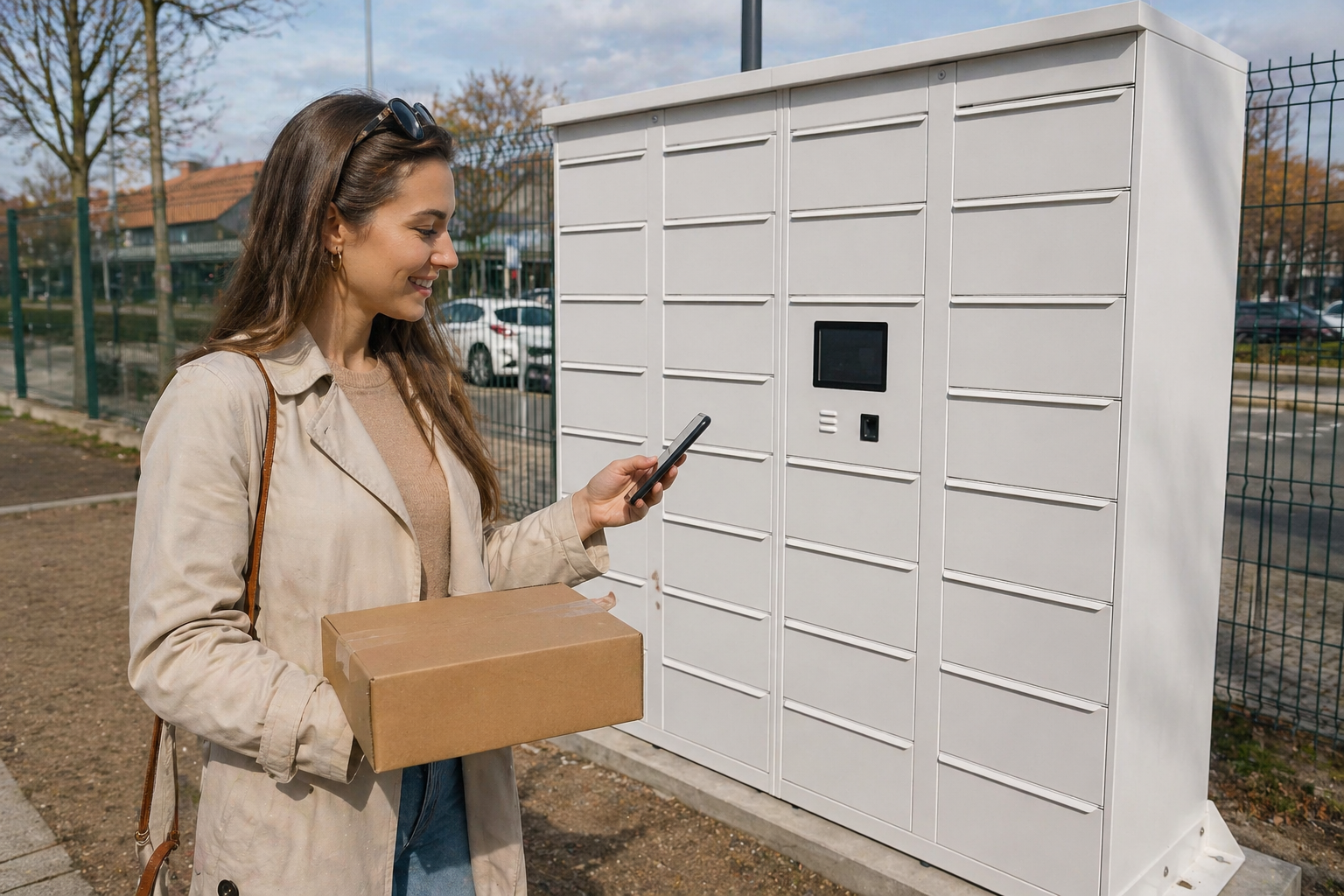
The concept of a "competitive moat" — a structural advantage that is difficult and expensive for competitors to replicate — applies with particular force to PUDO infrastructure. Here is why.
Network density is a flywheel, not a linear asset. A PUDO point only generates value when it is accessible. Accessibility requires density. Density requires capital, partnership agreements, installation capacity, and operational reliability at every node. Once a 3PL has built or locked in a critical-mass PUDO footprint in a metropolitan area, late-entering competitors face a combinatorial disadvantage: they must simultaneously secure locations, install hardware, integrate software, and build consumer awareness. This takes 18–36 months in practice. The operator already in position compounds its cost advantage every quarter.
OOH delivery drives measurable stop consolidation. In operational terms, the economics are stark. A last-mile delivery van making 80 residential stops per route achieves an average stop density that cannot improve significantly without OOH consolidation. Route simulation models consistently show that injecting PUDO points into a route reduces stops by 28–35%, increases packages per stop to 8–15x the residential average, and cuts fuel and driver cost per parcel by 20–28%. For a 3PL handling 50,000 parcels per day, that differential compounds into millions of euros in annual operational savings.
PUDO infrastructure converts failed deliveries from a cost into a service. The industry average for first-attempt delivery failure sits between 20% and 30%. Each failed attempt costs an operator approximately €3–5 in direct redelivery cost, plus indirect costs in customer service contacts and NPS damage. A dense PUDO network with consumer-facing 24/7 availability eliminates the majority of this failure rate structurally — not by improving delivery execution, but by removing the dependency on recipient presence altogether.
Traceability becomes a contractual differentiator. Enterprise shippers — retailers, pharmaceutical distributors, fashion brands, electronics manufacturers — are increasingly demanding end-to-end chain-of-custody documentation as part of their carrier contracts. A PUDO network built on digitally audited, access-controlled smart lockers produces a complete, timestamped event log from depot injection to recipient collection. This level of traceability is becoming a de facto qualification criterion in tender processes, particularly in regulated sectors.
Cold chain PUDO unlocks premium verticals. Temperature-controlled PUDO infrastructure (2–8°C for pharmaceutical and premium food; -18°C for frozen) is the frontier differentiator for 3PLs targeting grocery delivery, pharmaceutical last-mile, and meal kit distribution. This is not a niche: online grocery in Europe is projected to represent 10–12% of total grocery spend by 2027, and pharmaceutical home delivery is a rapidly expanding category driven by chronic disease management and post-hospital discharge protocols. Operators with refrigerated smart locker infrastructure at PUDO points can capture contractual volumes that ambient-only networks cannot serve.
Building a PUDO network that functions as a competitive moat requires more than placing hardware at convenient locations. The operational architecture must be designed for scale, reliability, and integration from the outset.
Hardware modularity determines deployment speed. Smart locker infrastructure deployed in PUDO contexts must accommodate variable compartment mixes — different size ratios depending on the parcel profile at each location, with the ability to reconfigure without replacing the unit. Locations near pharmaceutical retail or food services require native refrigerated compartments, not aftermarket retrofit solutions. Modular hardware that can be specified per location reduces both capex per node and time-to-revenue.
Software integration is the operational backbone. A PUDO network generates value only when each node is visible, manageable, and responsive in real time. The software layer must deliver: live occupancy monitoring across all network nodes, remote configuration and incident management without field visits, automated consumer notification workflows (SMS/email/app), open API connectivity to carrier TMS and WMS systems, and complete audit logs for SLA compliance and chain-of-custody certification. Without this software layer, a hardware-only PUDO network creates operational complexity rather than solving it.
Data generated at PUDO points is a strategic asset. Every transaction at a smart locker node — deposit time, compartment dwell time, collection latency, failure rate, peak usage patterns — constitutes operational intelligence. 3PLs that capture and analyse this data can optimise route injection timing, predict compartment saturation, negotiate better location terms with retail partners, and build differentiated SLA offerings for enterprise shippers. The operators who treat PUDO infrastructure as a data source, not just a delivery endpoint, will generate structural advantages that hardware-only competitors cannot match.
Interoperability with carrier ecosystems is non-negotiable. In a market where shared PUDO networks (multi-carrier access to the same locker unit) are becoming the commercial norm — particularly in high-density urban locations where real estate cost makes single-operator nodes economically marginal — the software platform underpinning the locker must support multi-carrier access control, separated event logging per carrier, and carrier-specific consumer notification flows. Platform lock-in at the hardware layer is a deployment risk; open API architecture is a commercial requirement.
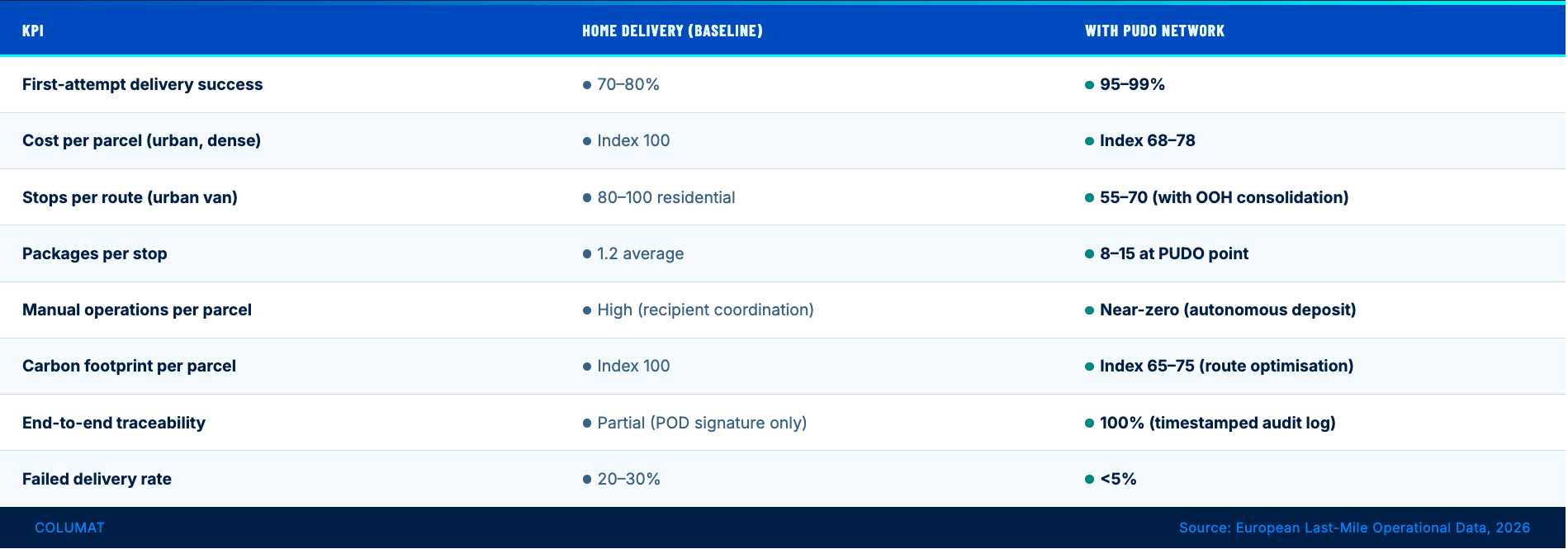
The business case for PUDO network investment is no longer theoretical. Operational data from European last-mile deployments points to consistent performance benchmarks:
KPIBaseline (home delivery)With PUDO networkFirst-attempt delivery success70–80%95–99%Cost per parcel (urban, dense)Index 100Index 68–78Stops per route (urban van)80–100 residential55–70 (with OOH consolidation)Packages per stop1.2 average8–15 at PUDO pointManual operations per parcelHigh (recipient coordination)Near-zero (autonomous deposit)Carbon footprint per parcelIndex 100Index 65–75 (route optimisation)End-to-end traceabilityPartial (POD signature only)100% (timestamped audit log)Failed delivery rate20–30%<5%
From a financial model perspective, for a 3PL network handling 30,000–50,000 parcels per day in an urban cluster, the net present value of a 150-node PUDO network — accounting for hardware amortisation, installation, software licensing, and maintenance — typically reaches payback within 18–24 months when carrier volume assumptions are met at 65%+ node utilisation.
What is a PUDO network in last-mile logistics?PUDO stands for Pick-Up Drop-Off. In last-mile logistics, a PUDO network is a distributed infrastructure of physical collection points — smart lockers, staffed retail counters, or hybrid installations — where carriers deposit parcels for recipient self-collection, eliminating the dependency on recipient presence at the point of home delivery. PUDO networks are the primary infrastructure layer for Out-of-Home (OOH) delivery.
Why are European 3PLs investing in OOH delivery infrastructure in 2026?Three converging pressures are driving investment: rising failed home delivery rates (20–30% of attempts), structural cost pressure on per-parcel margins, and tightening urban access restrictions in over 180 European cities. OOH delivery via PUDO networks reduces cost per parcel by 20–35%, cuts failed delivery rates to below 5%, and provides a traceable, scalable alternative to residential delivery that compounds in value as network density increases.
What is the difference between a PUDO point and a smart locker?A PUDO point is a generic term for any collection point — it can be staffed (a retail store counter) or unstaffed (an automated locker). A smart locker is a specific type of PUDO infrastructure: automated, access-controlled, connected, and able to generate a full digital audit trail. Smart lockers are the preferred PUDO format for high-volume, high-traceability, and 24/7 availability use cases because they operate without staff dependency.
How does a PUDO network become a competitive moat for a 3PL?Network density creates a compounding advantage. Once a 3PL reaches critical-mass coverage in a metropolitan area, competing operators must simultaneously invest in hardware, locations, integrations, and consumer adoption — a process that takes 18–36 months. Meanwhile, the incumbent operator continues to improve unit economics through higher node utilisation. The result is a durable cost and service advantage that is difficult and expensive to replicate from zero.
What role does temperature-controlled infrastructure play in PUDO networks?Refrigerated smart lockers (2–8°C) within PUDO networks enable 3PLs to serve pharmaceutical last-mile, premium grocery delivery, and meal kit distribution — high-growth, high-margin verticals that cannot be served by ambient-only networks. As European online grocery and pharmaceutical home delivery continue to grow, cold chain PUDO capability transitions from a differentiation feature to a table-stakes requirement for operators targeting these sectors.
What software capabilities are required to manage a PUDO network at scale?A scalable PUDO management platform requires: real-time visibility across all network nodes, remote configuration and incident resolution, automated multi-channel consumer notifications, open API integration with carrier TMS/WMS systems, multi-carrier access control for shared networks, and complete timestamped audit logs for SLA compliance and chain-of-custody reporting. Operators that manage PUDO networks with fragmented, non-integrated tools face operational complexity that offsets the cost advantages of the physical infrastructure.